A loss of bridge control, typically of steering, can have severe consequences for people, property and the environment. In confined or congested waters, where immediate hazards, such as shallows, other vessels and objects are in close proximity, crew response time and measures are critical. Seconds count, which only serves to make it more challenging to methodically process regaining control.
Written by

Mark Russell
Vice President, Global Claims Lead, Safer with Gard
Published 04 September 2026
Usually, these situations are brought about by a mechanical or electrical control failure, and the bridge can call on back-up modes, which is where we start in the first in a series of three insight articles. We will then consider steering and propulsion control settings applied by the crew, which can be a cause of accidents in fully functioning systems. In the last article we put the human element into context by considering performance influencing factors relevant to those accidents.
FU, NFU and emergency steering
The primary steering mode on a ship is the FU (Follow-Up) mode, where the rudder follows the exact position of the applied helm. The helm order data signal to the steering gear telemotors is provided by potentiometers that are mechanically linked to the helm wheel and electrically linked to the telemotors. The typical back-up steering on a ship is the NFU (Non-Follow-Up) mode. This is non-automated and is usually a spring-loaded lever on the bridge helm console that must be held to one side or the other for a signal to be sent direct to the telemotors. When the NFU lever is released, it springs back to the centre. The rudder does not follow-up, it stays at the angle achieved for as long as the lever has been held to one side. The bridge helm console(s) will usually have a switch to change between FU mode, NFU mode and Autopilot, the latter also being integrated with FU mode.
Emergency steering from the steering gear room provides an independent local control system, but it usually takes some minutes for crew to get to the steering room and take direct control in communication with the bridge. SOLAS (Regulation 26) mandates that this emergency procedure is drilled once every three months. The same regulation requires that the steering gear modes are tested by the crew within 12 hours of departure. Systems differ from ship to ship and, as we will see, understanding them and how the different steering modes operate are essential for rapidly responding to an actual failure.
Loss of steering - nine lives lost
The first accident we consider resulted in the tragic loss of nine crew following a collision between two vessels travelling in opposite directions in a deepwater channel.
The investigation found that the steering failure arose on one vessel when port helm was being applied, with the rudder becoming stuck at port 20°. The fault was a displaced locating pin in one of the potentiometers used in FU mode. The failure occurred when the vessels were only half a mile apart. A 22-knot closing speed meant there was only 1 minute and 30 seconds to act before the collision. The master immediately ordered the switch to NFU mode and hastily operated the NFU lever. However, there was no change to the rudder angle so the master diagnosed a further malfunction and ordered emergency steering at the steering gear room. By then it was too late and - as shown in the image below - the vessel continued to veer across the channel striking the other vessel broadside.
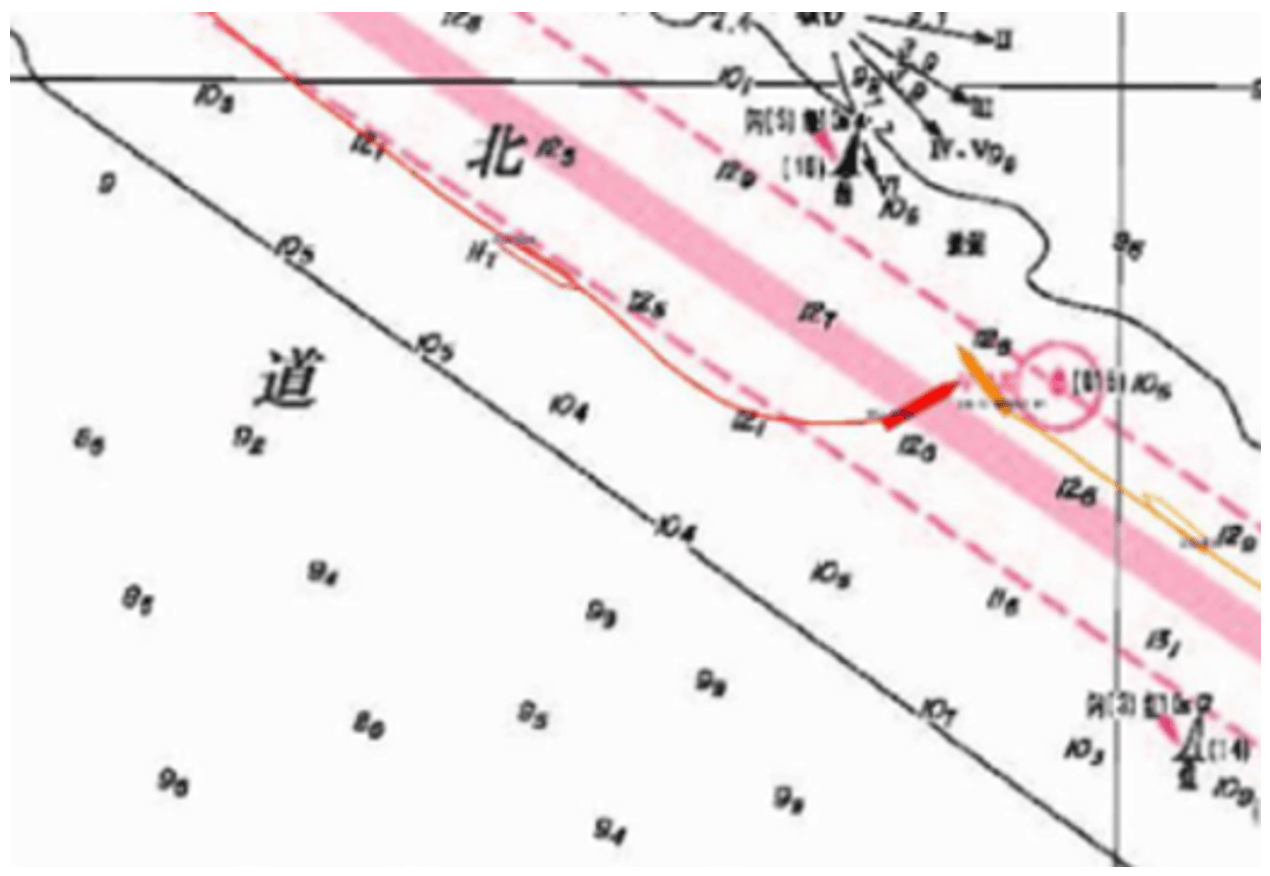
The force of the collision ultimately caused the other vessel to sink with her 16 crew. Fortunately, seven survived. The investigation found that in panic the third officer did not confirm that he had activated the NFU switch and that, in haste, the master used the NFU lever before the third officer had completed the switch to NFU mode. NFU steering was found to be functioning normally and the master had made an incorrect diagnosis that there was also a problem with the NFU mode.
Lost steering - auto NFU
In another accident involving an undetermined technical failure there were two and a half minutes between the failure of the rudder to respond and the grounding. Despite the stressful situation and a multitude of alarms, the immediate actions on the bridge were found to be correct – the helmsperson immediately reported the problem and steps were taken to prepare the anchors.
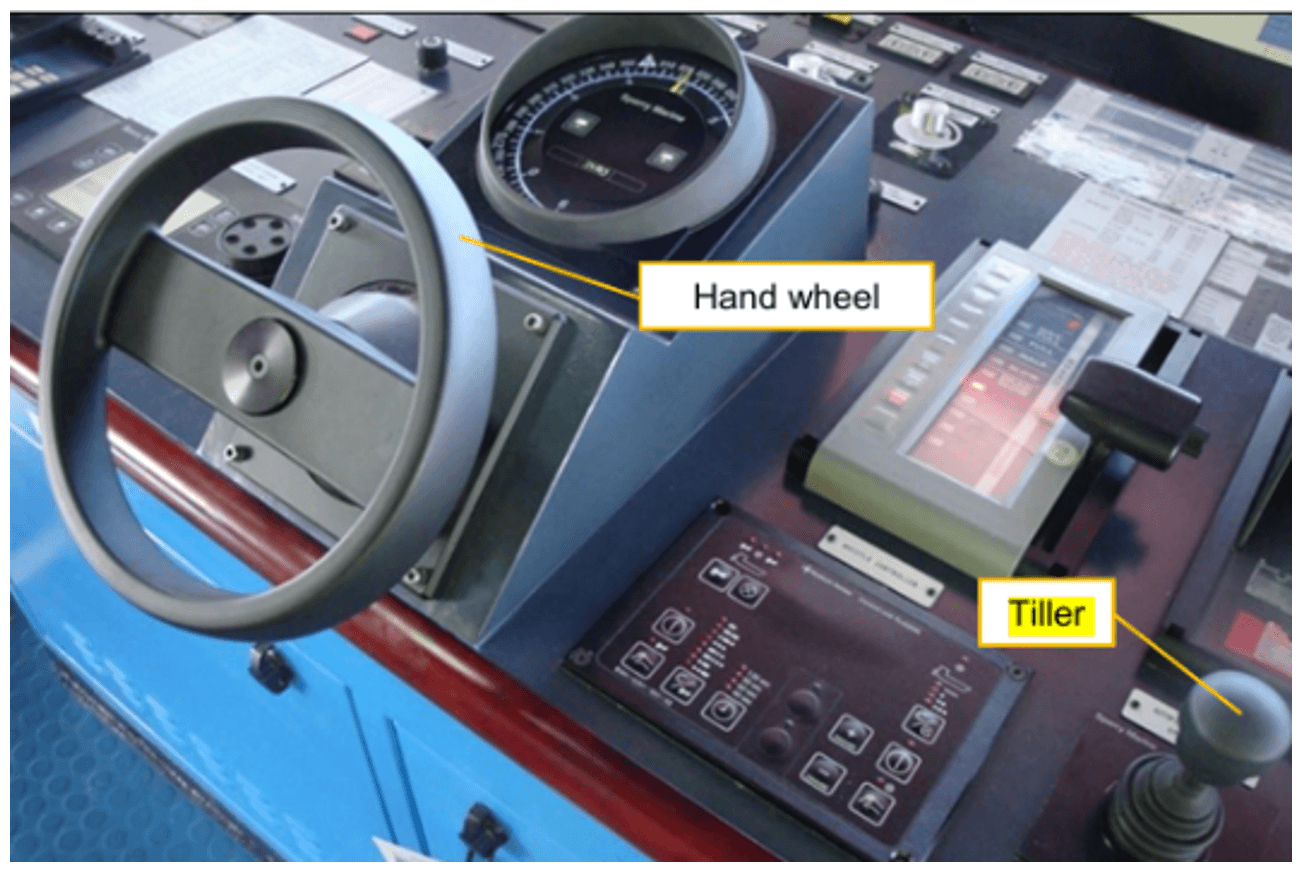
However, the investigation revealed that the crew were unaware of an automated override when the steering failure occurred. Unlike, in previous accident, where NFU mode had to be selected, the control system in this case automatically disabled the FU mode and engaged the NFU mode. Helm orders to rescue the situation therefore had no effect through the hand wheel and there was no attempt to use the separate NFU tiller joystick that had taken control of the rudder.
Lost steering when transferring between control stations or modes
Failures have a habit of occurring when transferring between control stations or modes, so it is important to be alert and ready to follow back-up procedures. Transferring between control stations is very common during port manoeuvres. In one accident a micro switch failure occurred when transferring control from the bridge wing to the centre control station in the bridge. This occurred in a port channel when the vessel was needing to make a starboard course alteration. Instead, the failure caused the rudder to swing hard to port, with the vessel eventually striking another vessel alongside. The investigation found that a contributing factor was a delayed use of the NFU mode, which came after a minute of other unsuccessful steps.
Transferring between autopilot and manual steering modes is also frequently done in more open waters where autopilot frees time to focus on important watchkeeping tasks, avoids the risk of hand steering errors and maintains course more efficiently. In higher-risk traffic and navigation areas it is recommended to use manual steering.
Strangely in one accident that caused significant damage to the vessel and a quay, the transfer from manual to autopilot occurred during a river transit. This was at the request of the pilot with the vessel proceeding at 10 knots and a few hundred meters away from the riverbank. A fault with an electrical relay component caused the rudder to take a sudden and strong deflection to starboard, before moving back towards midships.
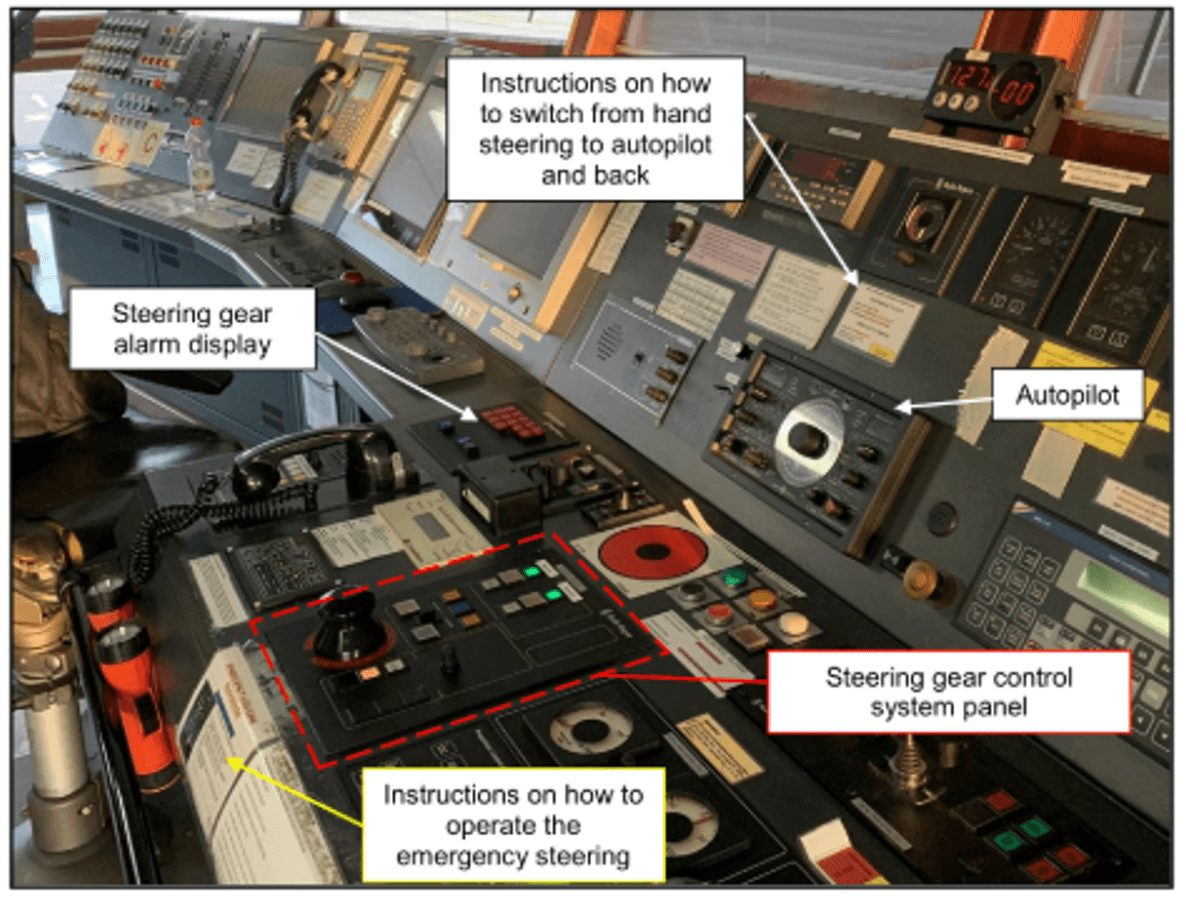
Attempts were made to switch back to manual FU mode, but this required the wheel (a rotary dial rather than a classic steering wheel) to be sufficiently aligned with the actual rudder position. The investigation found that the bridge team was not fully aware of this requirement, nor was it reflected in written transfer instructions posted on the steering console.
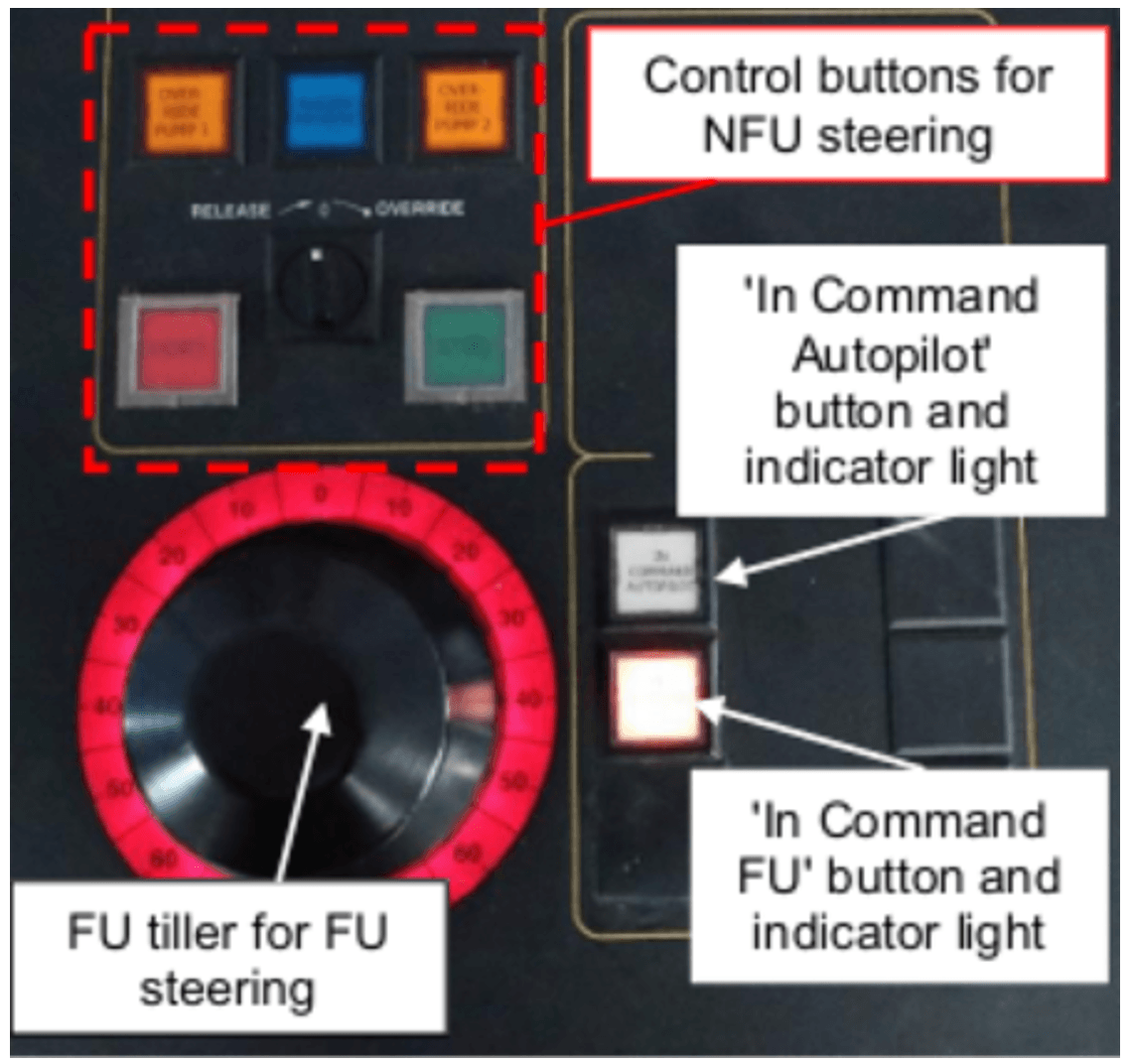
Concluding thoughts - drill back-up procedures
Whilst investigators in some of the above accidents felt that quicker application of back-up modes may not have made a significant difference to the outcomes, that will not always be the case. The point and angle of contact can make all the difference and in the first accident the consequences were fatal. Steering systems are usually reliable, meaning crew have much less experience using back-up modes. Different ships may have different systems and set-ups, so knowledge of the current ship may get mixed with memories from other vessels.
Drills have an essential role to play in testing response to the loss of critical controls on a specific ship. They can reveal a need to improve the clarity of quick response procedures and/or the crew’s familiarity with them. The mandated SOLAS drill must include direct control from the steering gear room, but it is recommended to extend that to drilling back-up modes on the bridge. Several investigations also referred to the challenges of dealing with a multitude of alarms at the time of failure. Studies have been conducted into alarm overload and how human-centric alarm management can serve the crew rather than overwhelm them.
The next article in the series will consider accidents brought about by system settings applied by the crew and where the outcomes could have been much less severe. In an era of increasingly sophisticated bridges and integrated systems, the accidents serve as a stark reminder of risks at the interface between humans and machines.
Related Articles


Gard is a member of