In 2025, numerous vessels arriving in Canada and the United States were found carrying flighted spongy moth complex egg masses, and some were so heavily infested that they were denied port entry. With populations in the moth’s native Asian region potentially reaching outbreak levels again in 2026, strict pre-departure inspection and certification at affected regional ports are essential.
Published 07 April 2026
Flighted spongy moth complex (FSMC) is a group of exotic pests native to Eastern Asia. It includes Lymantria dispar asiatica, Lymantria dispar japonica, Lymantria albescens, Lymantria umbrosa, and Lymantria postalba. Heavy infestations can strip trees and shrubs of their leaves, resulting in the decline and death of forests, orchards, and landscapes. The introduction of the FSMC into a country where it is not native would present a serious threat to its trees.
Ports and countries to monitor
FSMC populations are established in some port areas of Northern China, Korea, Japan, and the Russian Far East, and they are known to spread via ocean-going vessels involved in international trade. As a result, several countries actively work to prevent FSMC introductions, requiring visiting vessels to be inspected and certified as free of FSMC before departing these Asian ports.
Countries known to carry out seasonal FSMC inspections to prevent infestations include Canada, the United States (US), Chile, New Zealand, Argentina, and Australia. However, authorities in other countries may also be vigilant against this invasive and destructive pest.
High risk season: May to October
FSMC experiences outbreak periods characterised by very high population numbers. These outbreaks typically occur between May and October, although timing can vary depending on the specific location of each Asian port and local climatic conditions. During these outbreaks, adult females, which are strong fliers and attracted to lights at night, are highly likely to lay egg masses on illuminated surfaces. This behaviour allows FSMC to hitchhike to new areas, either as egg masses or, occasionally, as pupae, on vessels and their cargo.
FSMC egg masses are tolerant of extremes in temperature and moisture. Because of this resilience, larvae can hatch months or even years after the eggs are laid. This is also why vessels that have visited infested ports can remain a risk long after departure and why some countries may conduct seasonal inspections for up to two years following a vessel’s visit to Asian ports.
FSMC requirements
There is no single internationally agreed regulation for managing FSMC risks. While many authorities refer to the most recent recommendations provided by the North American Plant Protection Organization (NAPPO), national regulations still vary.
All countries known to enforce FSMC measures require arriving vessels to declare whether they have visited regulated ports in Asia during specified risk periods (SRP), when the likelihood of egg mass deposits is high. Most also require such vessels to be inspected and certified free of FSMC by a recognized certification body. However, requirements and port-of-entry procedures still differ between countries, and even the definitions of regulated areas and the timing of SRPs in Asia are not fully aligned.
To help vessel operators and masters stay informed and compliant, we have compiled and tabulated the key FSMC requirements for each relevant country.
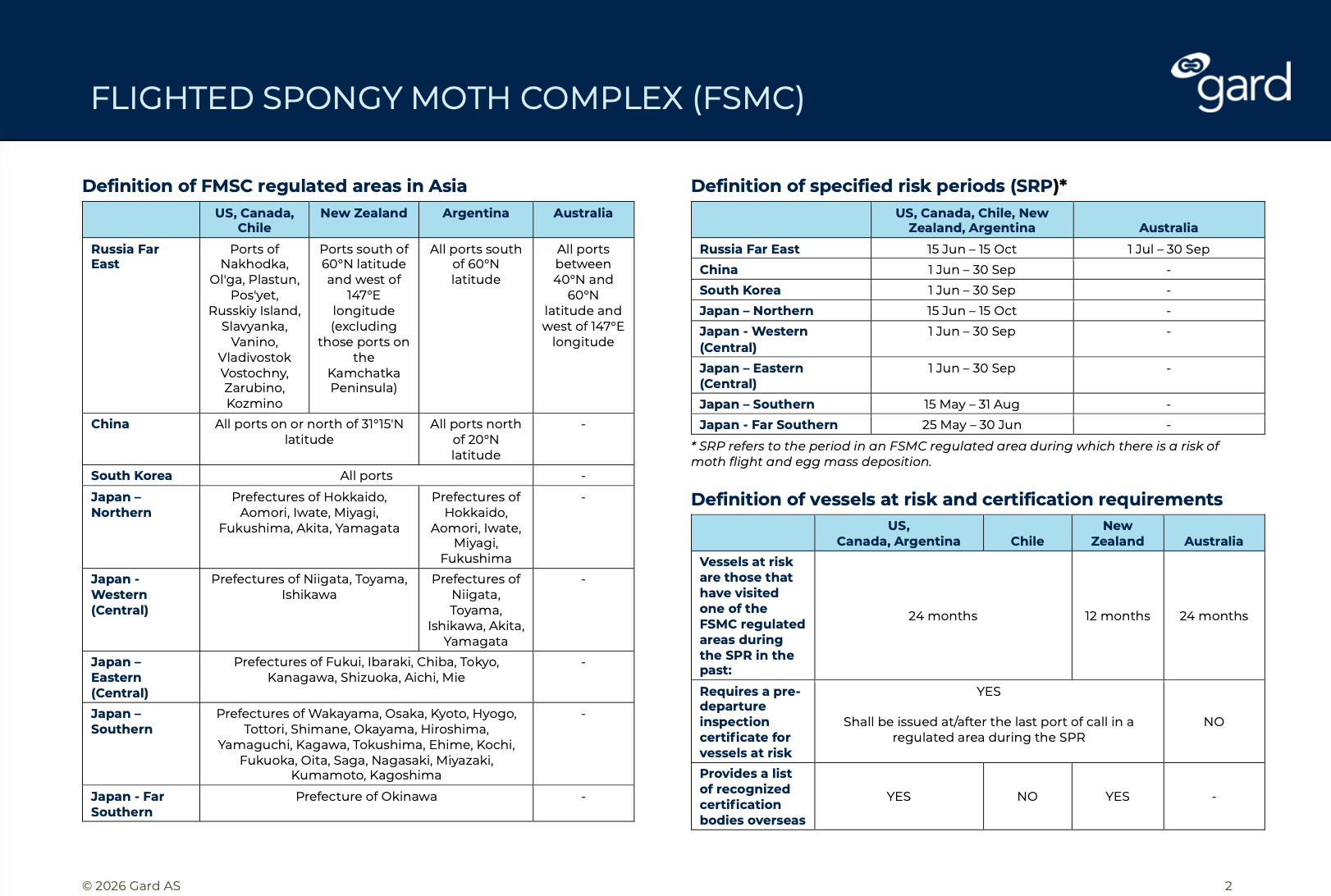
The following should be noted:
Canada and the US work together to manage FSMC risks, aligning their policies on FSMC regulated areas and SRPs with the most recent recommendations by NAPPO. Vessels that have called at a port in a regulated area during the SRP within the past 24 months must arrive at North American ports free of FSMC and should have obtained pre-departure certification from a recognized overseas inspection and certification body. In addition to certification, vessels are requested to exercise extra vigilance through self-inspections during the voyage to prevent arriving with egg masses.
Chile’s policy on FSMC regulated areas and SRPs is aligned with that of NAPPO, and therefore with Canada and the US. The same goes for the pre-departure certification requirements. However, unlike Canada and the US, Chile does not maintain its own list of recognized overseas inspection and certification bodies, instead referring to the local phytosanitary authority of the vessel’s country of departure.
Argentina’s policy on FSMC regulated areas and SRPs largely mirrors that of NAPPO and therefore aligns with Canada, the US and Chile. The same goes for the pre-departure certification requirements. However, Argentina additionally defines its regulated ports in Asia as "all ports located between 20° and 60°N latitude”. Unlike the three other countries, Argentina defines Akita and Yamagata Prefectures as part of Western Japan, which has a different SRP than Northern Japan. Like the US and Canada, Argentina maintains its own list of recognized overseas inspection and certification bodies.
New Zealand’s policy on FSMC regulated areas and SRPs is aligned with that of NAPPO, and therefore with Canada, the US, and Chile. However, unlike these countries, only vessels that have visited a regulated port during the SRP within the past 12 months are required to present a valid pre-departure certificate.
Australia targets vessels that have visited ports in the Russian Far East between 40ºN, 60ºN and west of 147ºE, anytime between 1 July and 30 September in the previous two calendar years. Unlike other regulating countries, Australia does not require pre-departure FSMC certification. Vessels classified as elevated risk will be assessed by Australian authorities to determine whether an FSMC
inspection is needed on arrival and will be notified as part of first port arrival formalities.
Port entry requirements
Vessels entering a regulating country may be inspected at any time of the year to verify that they are free from FSMC. However, some countries may designate specific periods with heightened surveillance and more systematic inspection. For example, in Canada, FSMC certification requirements apply during the spring and summer, from 1 March to 15 September in western ports and 15 March to 15 September in eastern ports. In Australia, heightened vessel surveillance for FSMC typically occurs from January to May each year.
If FSMC egg masses are detected during inspection, vessel requirements vary by country and consider local climate at the time of entry, the level of infestation, and the developmental stage of the egg masses detected. In some cases, vessels may berth and be cleaned and treated with insecticide while alongside. In other cases, if large amounts of fresh, viable egg masses are found, the vessel may be required to leave territorial waters immediately.
It is recommended to contact the vessel’s local agent well in advance to confirm the FSMC entry requirements in effect at the time of arrival.
Reduce your vessel’s risk of FSMC infestation
Operators and crews should keep vessels well-maintained, and decks clear of debris and unnecessary obstacles to allow thorough inspections during and after visits to high risk Asian ports. Implementing systematic self-inspection routines while underway is also an effective way to prevent delays or re-routing at subsequent ports.
Various authorities have published downloadable guides for conducting vessel self-inspections. These guides offer crews practical instructions on identifying FSMC egg masses, understanding the areas onboard where they are most likely to be found, and properly removing and destroying them. Examples include Canada’s Inspect Before Entry guide and New Zealand’s Don't bring hitchhikers to New Zealand for commercial vessels. The US’ FSMC webpage also features a useful picture gallery under the "What To Look For" section.
In summary, in addition to obtaining pre-departure certification, vessel crews should:
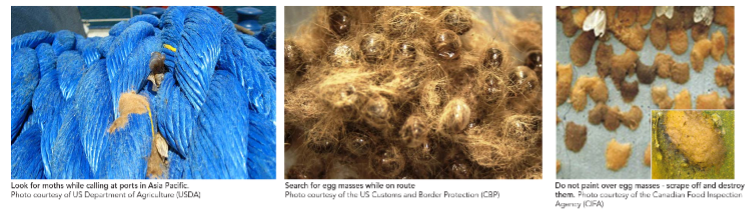
Carry out thorough visual inspections of all accessible areas of the superstructure, decks, holds, cargo, and cargo gear. Use binoculars to check hard-to-reach areas. Egg masses are often deposited in sheltered locations, crevices or cavities, under tarps, behind doors, around light fixtures, and underneath cargo hold rims. Remember that female FSMCs are attracted to light and that egg masses may be deposited on surfaces exposed to night lighting.
Scrape off any egg masses found and destroy them in alcohol, boiling water or by incineration. Do not paint over egg masses or drop them into the sea, as this will not kill the eggs or larvae.
Record all inspections and removals in the vessel’s deck logbook, including details FSMC egg mass disposal methods.
Note also that BIMCO has developed a generic Flighted Spongy Moth Complex Clause for Time Charter Parties that provides a commercial solution focussing on the basic obligations and responsibilities of the owners and the charterers.
Related Articles


Gard is a member of